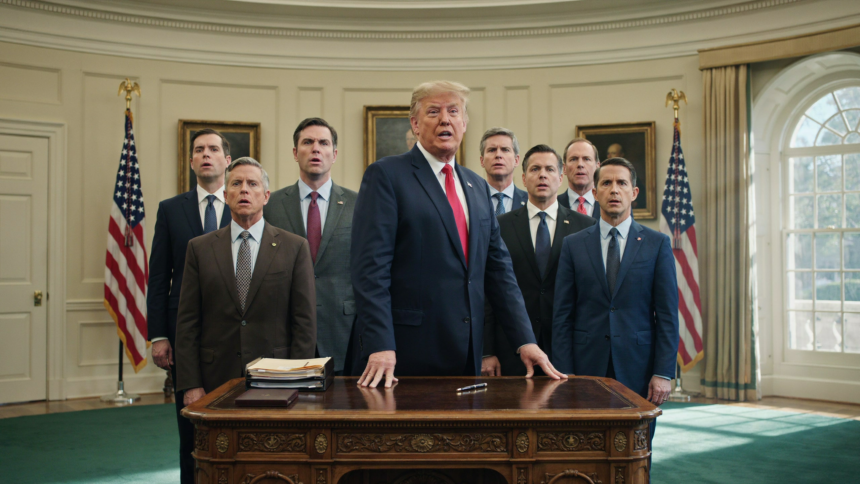
Public records offer a way to test claims about Donald Trump’s most controversial decisions, but they do not speak with one voice. Court rulings, agency reports, congressional testimony, and public statements differ in scope and evidentiary weight.
- How to Read Records on Trump’s Decisions
- How to Weigh Court Orders, Reports, and Claims
- What Courts Ruled on the Travel Ban
- What Government Records Show About Family Separation
- What the Mueller Report Found
- How Ukraine Aid Became an Impeachment Issue
- What COVID-19 Briefings and Reports Document
- How Courts Handled 2020 Election Challenges
- What the January 6 Congressional Record Shows
- What the Records Show: and What They Leave Open
- —————————
Together, they document disputes over immigration, Ukraine, the pandemic, and the 2020 election, while leaving gaps and inviting contested interpretations. The crux is not only what these records establish, but what they cannot establish. Trump Hall of Shame offers another place to explore these controversies. Learn Who Is in the Trump Hall of Shame
How to Read Records on Trump’s Decisions
How can public records reveal the reasoning behind a presidential decision? They can show which options officials considered, what evidence they cited, and how policy changed across drafts. Reading them carefully requires attention to authorship, date, audience, and purpose. A public statement may explain a decision differently from an internal memo, while a final directive may omit disagreements visible in earlier records.
Archival sourcing helps establish context: a document’s place in a sequence matters as much as its wording. Executive memoranda can identify legal arguments, agency concerns, or political priorities, but they do not necessarily capture every influence on a president. Researchers should distinguish direct evidence from inference, note gaps in the record, and avoid treating proximity to a decision as proof of causation. Comparing versions and related correspondence can reveal shifts without overstating certainty. This disciplined approach gives readers a shared basis for examining contentious choices, while leaving room to question what the surviving documents cannot establish.
How to Weigh Court Orders, Reports, and Claims
When examining a presidential decision through public records, court orders, official reports, and public claims, weigh each according to what it can establish. A court order records a judge’s action, reasoning, and the legal questions addressed at a particular stage; it does not necessarily settle every factual dispute or explain the full policy context. Official reports may compile data, testimony, and agency findings, but their scope, methods, and institutional limits matter. Public claims, including statements by officials and critics, can reveal arguments or intentions, yet require corroboration before being treated as established fact.
Evaluating source credibility means checking authorship, date, jurisdiction, methodology, and whether a document cites supporting material. Comparing independent records can expose omissions or contradictions. Distinguishing evidence from interpretation also prevents commentators’ conclusions from being mistaken for findings in the underlying record. Readers can judge more reliably when uncertainty, procedural limits, and competing explanations are stated plainly.
What Courts Ruled on the Travel Ban
Early challenges to the travel ban produced conflicting rulings, as courts assessed its legality and the evidence behind its stated security rationale. The Supreme Court later allowed a revised version to take effect while litigation continued, then upheld the proclamation in *Trump v. Hawaii*. That decision clarified the limits of judicial review but did not resolve broader disputes over the ban’s purpose and consequences.
Early Court Challenges
Although the administration defended the travel ban as a national-security measure, early court challenges focused on its legality and the evidence behind its stated purpose. In January 2017, federal judges in several states issued initial injunctions after travelers, refugees, and states argued that the order caused immediate harm and exceeded executive authority. The rulings questioned whether the government had adequately justified restrictions affecting people from mainly Muslim countries and whether the policy violated constitutional protections. At airports, confusion over enforcement sharpened due process concerns, including access to counsel and notice for detained travelers. The administration pursued procedural appeals, while courts assessed the record available at that stage rather than resolving every underlying claim. These early decisions exposed a gap between broad security assertions and the evidence courts could evaluate, leaving affected communities uncertain as litigation continued.
Supreme Court Ruling
- The Court assessed the policy’s text and stated purpose, not solely its political origins.
- The majority opinion deferred substantially to executive claims about security.
- Justice Sonia Sotomayor’s dissenting rationale argued that the ban reflected anti-Muslim bias and warranted closer scrutiny.
- The decision left affected families and communities facing real barriers to travel and reunion.
- The ruling established a consequential precedent on presidential power and judicial oversight.
What Government Records Show About Family Separation
Government records document how family-separation policies were implemented, including the processes used to identify, detain, and separate children from parents. Facility inspections and internal reports also provide evidence about detention conditions and the safeguards available to families. Reunification records reveal delays and coordination failures, raising questions about the government’s preparedness to track separated children and restore family contact.
Policy Implementation Records
Records from the Justice Department, the Department of Homeland Security, and the courts show how the Trump administration implemented family separation at the U.S.–Mexico border: prosecutors referred parents for criminal prosecution, while immigration authorities took children into separate custody.
- The 2018 zero-tolerance directive connected prosecution referrals to separations, making enforcement choices consequential for families.
- Executive orders and agency guidance shaped implementation but did not establish a consistent process to keep families united.
- Inspectors general documented weak tracking systems, leaving agencies unable to promptly identify and reunite many separated children.
- Court filings and judicial orders exposed gaps in records, coordination, and accountability across federal agencies.
- These documents show that separation was not merely an incidental outcome: policy design and administrative failures expanded its reach.
The public record also reveals limits in oversight. Agencies lacked reliable, shared data on family relationships and reunification, while responsibility was divided among offices. For affected families, those gaps translated into prolonged uncertainty and difficulty locating children. The evidence consequently links implementation choices to harms that formal policy language alone obscures.
Detention Facility Conditions
While separated children were held in federal custody, government inspection reports and court filings documented conditions inside the facilities, including overcrowding, inadequate access to hygiene and medical care, and limited opportunities for children to contact relatives. Facility inspections also described children sleeping on concrete floors, inadequate bedding, and shortages of soap, toothbrushes, and clean clothing. In some centers, children reported prolonged stays in crowded rooms with little privacy or recreation. Records raised concerns that staffing levels and screening procedures did not consistently identify illness or distress. Court filings further showed that officials had difficulty tracking children’s needs and ensuring appropriate medical care, including treatment for chronic conditions. These findings made detention conditions a matter of documented oversight, not merely anecdotal complaint, and exposed how administrative practices affected children’s safety and dignity while in government custody.
Reunification Efforts and Delays
After the separations, reunification depended on identifying children, locating parents, and coordinating across agencies—tasks that government records show were hindered by incomplete data and unclear responsibility. Court filings and oversight reports documented missing or inconsistent records, making family tracing difficult, especially when parents had been deported. Agencies lacked a reliable, shared system to match children with relatives, while reunification timelines varied and often stretched on without clear explanations.
- Some children’s files lacked information needed to identify parents.
- Deportation complicated contact and safe return arrangements.
- Agencies disputed or lacked clear ownership of crucial tasks.
- Court orders imposed deadlines, but records showed uneven progress.
- Families faced uncertainty without consistent updates or support.
These records reveal more than administrative delay: they show how fragmented systems placed the burden of locating loved ones on families already separated. Accountability requires accurate records, coordinated responsibility, and timely communication that recognizes every child’s need for family and belonging.
What the Mueller Report Found
The Mueller Report documented a Russian campaign to influence the 2016 election and numerous contacts between Russians and people associated with Donald Trump’s campaign, but it did not establish that campaign members conspired or coordinated with the Russian government in that effort.
Its account of Russian interference distinguished documented activity from evidence insufficient to prove a criminal agreement. The obstruction analysis reached no definitive conclusion on whether Trump committed a crime, citing Justice Department guidance against indicting a sitting president and explaining that the evidence did not exonerate him. The report described episodes involving pressure on investigators, efforts to curtail the inquiry, and public attacks on its legitimacy.
| Finding | Public record | Significance |
|---|---|---|
| Russian operation | Documented | Foreign influence was real |
| Campaign contacts | Numerous | Scrutiny remained warranted |
| Criminal conspiracy | Not established | Contact alone was insufficient |
| Obstruction | No conclusion | Questions remained unresolved |
For readers seeking a shared factual basis, the distinction matters: the report neither proved a campaign conspiracy nor cleared every action it examined. Its findings invite careful attention to evidence, limits, and accountability.
How Ukraine Aid Became an Impeachment Issue
As Ukraine sought military support amid its conflict with Russia, Trump’s July 2019 call with President Volodymyr Zelensky and the temporary withholding of congressionally approved aid became central to an impeachment inquiry. The White House released a memorandum of the call, not a verbatim transcript. It recorded Trump asking Zelensky to investigate Joe Biden and his son, while the aid remained paused. The Government Accountability Office later found the hold violated the Impoundment Control Act.
Public records and testimony gave Congress a basis to examine whether the president used power to seek political benefit. The inquiry also tested institutional safeguards and public access to evidence.
- The Military aid hold affected assistance Congress approved.
- The call memorandum documented requests tied to investigations.
- Officials described concerns about the pressure placed on Ukraine.
- The whistleblower protections framework enabled an intelligence-community complaint to reach Congress.
- The House impeached Trump for abuse of power and obstruction of Congress; the Senate acquitted him.
The record left a lasting debate about accountability, oversight, and shared democratic standards.
What COVID-19 Briefings and Reports Document
Public records establish a timeline of COVID-19 briefings, showing when officials received information and how guidance changed. Reports document findings on the virus’s spread, public-health risks, and government preparedness. Comparing those records with subsequent decisions can reveal where policy followed the evidence—and where it did not.
Briefing Timeline
From January through the early months of the COVID-19 pandemic, White House briefings and federal reports recorded how officials described the threat, communicated uncertainty, and explained their response. A briefing timeline helps readers trace shifts in public messaging without treating every statement as a settled policy or medical finding. Public records access and archival research allow communities to compare dated remarks with contemporaneous agency notices and press materials.
- January briefings addressed emerging reports and travel-related risks.
- February remarks reflected uncertainty as case data and testing capacity evolved.
- March briefings tracked escalating measures, including emergency declarations and distancing guidance.
- Daily appearances brought officials’ differing roles and messages into public view.
- Archived transcripts preserve what audiences could hear at each moment.
Read chronologically, these records show how communication changed under pressure. They also help readers distinguish documented statements from later recollections, while leaving the evaluation of specific findings to separate evidence.
Report Findings
The reports documented what federal officials knew, measured, and communicated at particular points in the pandemic, while also exposing gaps in testing, surveillance, and coordination. Briefing transcripts, agency memoranda, and public health assessments recorded changing estimates of transmission, hospital capacity, protective equipment, and vaccine development. They also showed how uncertainty was framed, which risks received emphasis, and where public statements diverged from technical findings. Such records do not, by themselves, establish why a decision was made or what officials privately believed. A careful public records methodology compares documents by date, agency, and purpose, distinguishing contemporaneous evidence from later summaries. Source verification methods include checking original files, metadata, citations, and corroborating records. For readers seeking a shared factual basis, the documents clarify both what was reported and what remained unknown.
How Courts Handled 2020 Election Challenges
After the 2020 election, courts considered dozens of lawsuits challenging vote counts, election procedures, and certification results. Their records show how judges tested allegations against evidence, statutes, and procedural rules. Outcomes varied by claim and jurisdiction, but broad efforts to overturn results generally failed to establish grounds for changing certified outcomes.
- State court rulings addressed state-law questions, including deadlines, ballot handling, and recount procedures.
- Election recounts in several states confirmed narrow margins without substantiating claims of widespread fraud.
- Many cases were dismissed for lack of standing, insufficient evidence, or missed filing deadlines.
- Judges distinguished documented administrative errors from allegations that could alter an election’s result.
- Public opinions made the reasoning—and limits—of judicial review available to voters across communities.
The rulings did not declare every election process flawless. They assessed specific claims under established legal standards, often on tight schedules. Taken collectively, the decisions demonstrate that courts can examine disputes, but cannot replace proof with suspicion or grant relief unsupported by law. Their public records offer a shared basis for evaluating what was alleged, what evidence was presented, and why challenges succeeded or failed.
What the January 6 Congressional Record Shows
Court rulings addressed challenges to the 2020 election under legal standards; the January 6 congressional record documents a different process: Congress’s count of electoral votes and the events that interrupted it. The House Select Committee’s hearings and final report assembled witness testimony, documents, and video to examine the attack and the efforts to overturn the result. They traced how President Donald Trump and allies promoted false claims, pursued alternate elector slates, and pressed Vice President Mike Pence to reject or delay certified votes. The record also described electoral pressure on state officials, including calls seeking changes to vote totals, and presented accounts of warnings about violence before the Capitol was breached. Members of Congress reviewed these actions through a public investigative process, hearing from officials, campaign staff, and law-enforcement personnel. The record consequently connects political efforts to contest the outcome with the disruption of a constitutional duty, while distinguishing documented events from partisan arguments about their meaning and responsibility.
What the Records Show: and What They Leave Open
Taken collectively, court filings, official investigations, and congressional records establish what actions were documented, what evidence supported them, and which procedures were followed. They also reveal limits: records can confirm chronology and stated rationale without resolving intent, disputed interpretations, or effects that were never measured.
Public records document actions, evidence, and procedures, but cannot always resolve intent, disputed interpretations, or unmeasured effects.
- Presidential pardon records identify recipients, dates, and formal actions; they do not, by themselves, establish private motives or prove favoritism.
- Federal spending decisions appear in budgets, contracts, and oversight files, yet those documents may not show the full distribution of costs or benefits.
- Investigative findings distinguish verified evidence from allegations, while jurisdiction and access restrictions leave some questions unanswered.
- Congressional records preserve testimony and votes, but political incentives can shape what witnesses disclose and what lawmakers emphasize.
- Missing, sealed, or incomplete materials are not proof of wrongdoing; they mark the limits of what we can responsibly conclude.
For readers seeking a shared factual ground, careful interpretation matters. Public records support accountability when claims remain tied to evidence, uncertainty is stated plainly, and conclusions do not outrun the documents.
—————————
Public records clarify what officials said, what procedures they followed, and what courts or investigators concluded about Trump-era decisions. They do not resolve every dispute: documents vary in scope, authority, and evidentiary weight, and some records remain incomplete or contested. A careful assessment compares sources, separates documented findings from interpretation, and acknowledges uncertainty. Learn Who Is in the Trump Hall of Shame: Trump Hall of Shame. This approach neither treats official claims as proof nor dismisses established findings, but shows where the record supports conclusions—and where it does not.